Save Our Bacon is still a threat to animal welfare, environmental protection, and states’ rights
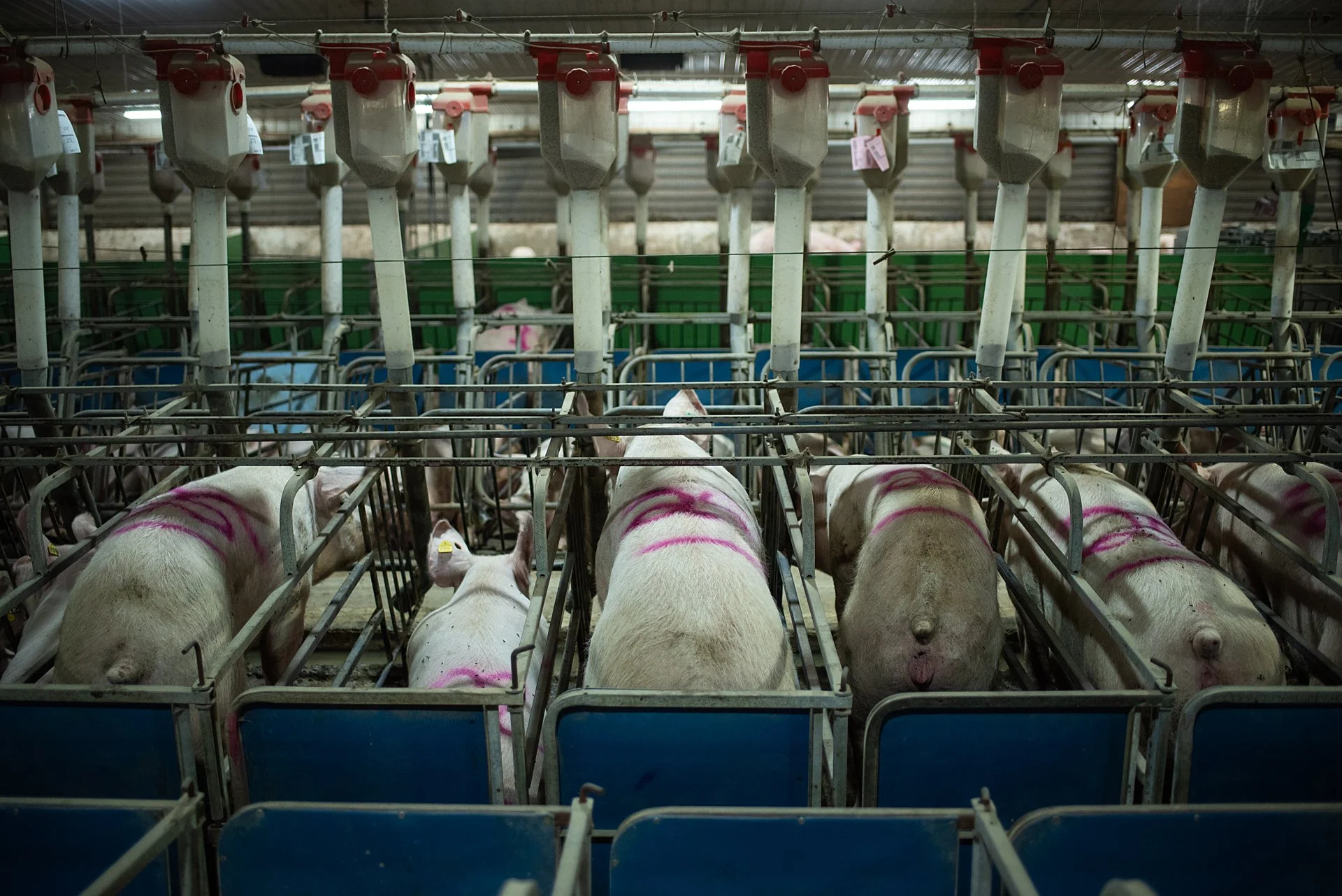
Sows in gestation crates. Photo credit: We Animals
As the Senate gears up to debate the Farm Bill, we want to follow up on our op-ed advocating against the “Save Our Bacon” provision. The most recent Farm Bill draft, which passed through the Senate committee, lacks this provision, even though it was contained in the House version of the bill. So while the coast is clearer now, there is still a possibility that this provision will be reintroduced, or that it will resurface in future legislation.
A response to our op-ed characterized it as containing charged, emotional language and a one-sided conception of federalism. The response’s author, Russ Hendricks of the Idaho Farm Bureau Federation, advocates for the continuation of gestation crates as veterinarian-approved technology that promotes productivity, welfare, and low prices. To accomplish this, Hendricks advocates for the Save Our Bacon provision, which ends state-level provisions, like California’s Prop 12, that currently make gestation crates illegal. He argues that Prop 12 makes California “a regulatory bully” that has been “hijacked by regional special interests”. Thus, his argument goes, California’s law urgently warrants a repeal at the federal level.
This response relies on a mischaracterization of our position and selective application of the principles of federalism. The title also implies that we as experts should “stay in our lane”, and so should California’s concerned voters, with the article elaborating that legitimate opinions on the subject can only come from people with direct experience in intensive animal agriculture.
This critique misses the mark. Our warning about the risks of “Save Our Bacon” rests on an accurate account of how animals are treated, takes seriously the tensions within federalism, and identifies concrete threats states’ abilities to regulate animal welfare, public safety, and the environment within their borders.
“Extreme confinement”
Hendricks takes particular exception to our use of the term “extreme forms of confinement”, claiming that our language was designed to provoke emotional reactions from readers. However, the question should be whether our language mischaracterizes animal treatment. It does not. Our best science has established that animals are sentient and live emotionally multifaceted lives. Gestation crates lead to well-documented physical and psychological harms from musculoskeletal disorders to stress behaviors due to their lack of physical exercise and a complete suppression of their natural instincts and behaviors. On the most basic level: the pigs cannot turn around. There is no more appropriate shorthand for this type of confinement than “extreme”; confinement literally cannot get any more stringent. Our use of the superlative “extreme” is accurate. If an accurate description of reality evokes an emotionally fraught response, then the problem is with reality, not the description.
However, Hendricks sidesteps the harm caused by these crates, arguing instead that “individual housing protects gestating sows from territorial aggression, injury and starvation caused by dominant pen-mates”. This humane-washes gestation crates. Whether or not gestation crates can prevent risks and injuries associated with other older forms of intensive housing is a distracting rhetorical maneuver. Modern forms of gestating sow conflict mitigation already exist, with higher welfare scores, such as automated feeders and shoulder-guard systems. These require greater land or building footprints, higher investments, or more active management. But importantly, they avoid extreme confinement that much of the public has already deemed ethically uncomfortable or unacceptable. These challenges have been dealt with in other countries for years, with positive results: Sweden and the UK have banned gestation crates since the 1990s and currently see lower rates of pig mortality than the US.
By urging us to “stay in our lane”, Hendricks defers to the authority of veterinarians in the US, who deem gestation crates to be a viable or necessary option for animal care. This is the position of leadership at the largest farm animal veterinarian organization in the US, the American Veterinary Medical Association (AVMA), which drafted letters in support of overturning California and Massachusetts laws. However, these letters were not drafted democratically with input from its membership and have drawn widespread criticism from veterinarians within and outside of its membership. The AVMA also has deep institutional and political ties to the industry, which is currently heavily invested in gestation crates. While veterinarian input is important, other forms of expertise — including philosophers, animal behaviorists, public health experts, and environmental scientists — can shed light on this issue as well.
As two experts in sustainability and animal sentience, we know that better alternatives exist, including alternative production models like hybrid indoor/outdoor housing systems such as those in the UK. More systematic solutions include wider dietary shifts, which would reduce our current need to squeeze high productivity out of every last farm and pig, along with the cumulative physiological and environmental stresses that such intensive systems entail.
Avoiding Federal Overreach
Hendricks’ second assertion is that our article “distorts the concept of federalism.” We argue that his response does so. He claims that California’s Prop 12 legislation exemplifies federalist overreach, accusing California of “bullying” other states regarding how they can produce food, and “dictating” what types of technologies, housing, and safety measures they can use. This language is hyperbolic and false. The Supreme court’s majority ruling already found that California does not unconstitutionally discriminate against interstate commerce. States can determine which products are sold within their stores as much as they determine how animals are farmed within their barns, as long as they don’t resort to outright protectionism.
Hendricks again accuses us of emotional rhetoric, because we note that Save Our Bacon would “dismantle state laws.” Again, the author confuses rhetoric with reality. “Dismantling state laws” is precisely what the legislation was designed to do. We did not claim that this repeal is unconstitutional. We stated that it was destructive, that it would lead to negative welfare and environmental consequences, and that it would supplant states’ laws with federal authority. While SCOTUS left a Prop 12 repeal open to Congress, this only means that the Save Our Bacon provision is not illegal. But it remains a bad idea. In either case, Hendricks has no constitutional basis for claiming that it is a “necessary correction that restores federalism”.
Legal Preemption Can Cause Real Harms
By portraying our position as over-emotional and under-informed about the rational decisions faced by farmers, Hendricks dodges the core substance of our argument. Save Our Bacon was designed to preempt state laws, and in doing so, it can cause real harm beyond repealing the animal treatment laws it was designed to target.
These pre-emptions include over 600 laws designed to ensure food safety, protect wildlife populations such as elk and bison, and safeguard public health. According to the Harvard Law School research, this includes laws designed to prevent the new world screwworm parasite from crossing over state lines with the livestock they infect, a spread that Southwestern states are currently struggling to control.
Health and safety services need strong regulations to function. Passing such a sweeping provision, designed to prevent states from regulating the sale of livestock or their products, could hurt our health defenses, wild animals, and the environment as a whole. The response to our article did not bother to engage with these reasons or evidence for our concerns. But this is our basis for characterizing Save Our Bacon, with its sweeping erasure of states’ policies, as dangerous.